

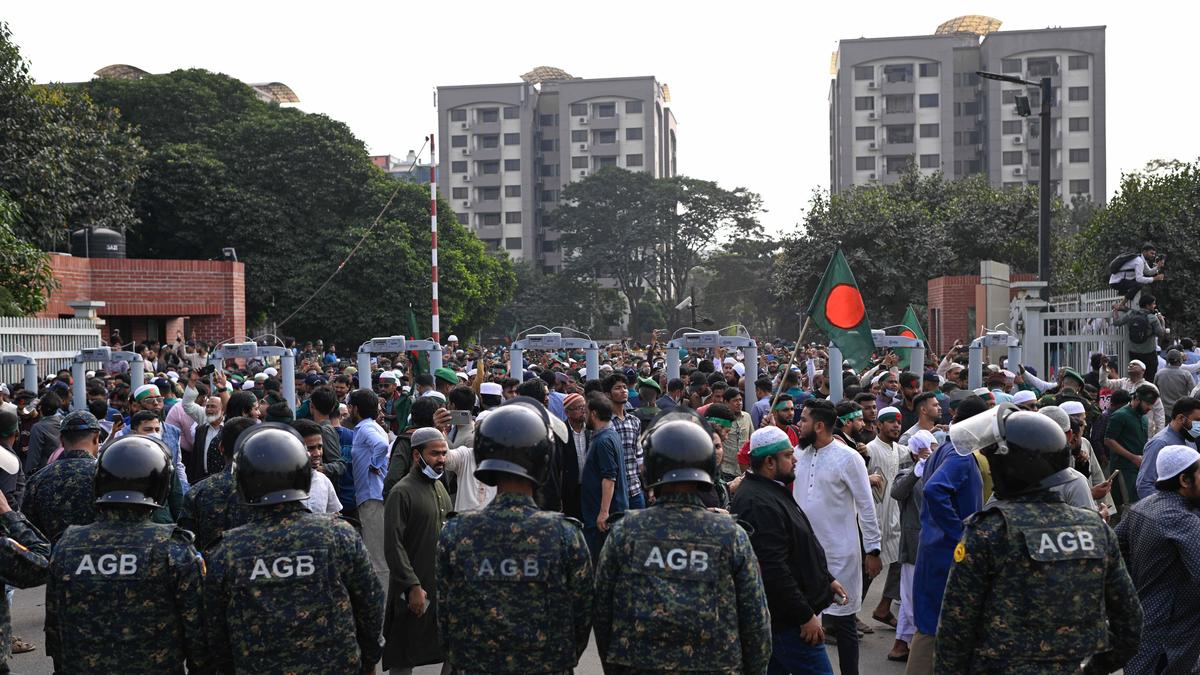
Bangladesh remained tense on Saturday as mass mourning for slain youth activist Sharif Osman Hadi transformed into fresh political pressure on the interim administration, with protesters intensifying demands for accountability and the resignation of the Home Affairs Adviser.
Hadi, a prominent figure of the July 2024 uprising, was laid to rest in Dhaka amid extraordinary security arrangements. Tens of thousands gathered near the National Parliament at Manik Mia Avenue for his funeral prayers, watched over by a heavy deployment of police and extensive use of body-worn cameras. Despite the controlled setting, grief quickly spilled into renewed demonstrations across the capital and beyond.
Anger has focused on the failure to arrest those responsible for Hadi’s killing, more than a week after he was shot in Dhaka on December 12. Protesters accuse Home Affairs Adviser Lt. Gen. (retd.) Md. Jahangir Alam Chowdhury of negligence, with socio-cultural group Inqilab Moncha issuing a 24-hour ultimatum for his resignation. Following the burial, mourners marched toward Shahbagh, raising revolutionary slogans and calling for the landmark intersection to be renamed in Hadi’s memory.
Chief Adviser Muhammad Yunus, who attended the funeral, sought to strike a conciliatory note, describing Hadi as a symbol whose ideals would endure. Referring to Hadi’s aspiration to contest elections, Yunus urged acceptance of a fair electoral process, even as doubts grow over whether national polls scheduled for February 2026 can proceed as planned.
The unrest has gone beyond street protests. Recent days have seen arson attacks on major media houses and cultural institutions, deepening fears of a broader assault on free expression and Bangladesh’s secular traditions. While newspapers such as Prothom Alo and The Daily Star resumed publication after their offices were torched, cultural groups like Udichi Shilpi Gosthi reported devastating losses, including decades of archival material, and accused authorities of appeasing extremist forces.
Human rights organisations have sounded alarms over the violence. Amnesty International called for an independent investigation into Hadi’s killing and condemned attacks on journalists, artists, and minorities. It also highlighted the lynching of a Hindu garment worker in a separate incident, underscoring concerns about rising mob violence. Police said seven suspects have been arrested in that case.
As calm tentatively returns to parts of the country, political leaders warn that instability could be deliberately stoked to disrupt the electoral timeline. Opposition figures have urged vigilance, cautioning that anti-election forces may exploit public anger surrounding Hadi’s death to delay the polls.
For now, Bangladesh stands at a crossroads, with the mourning of a young leader evolving into a broader test of law, accountability, and the future of its democratic transition.
 Nitesh Sharma